Beyond 100 × 35: The Story Behind CETL’s Mural

Author: Rosa M Laureano Marrero
Date: 11/05/2026
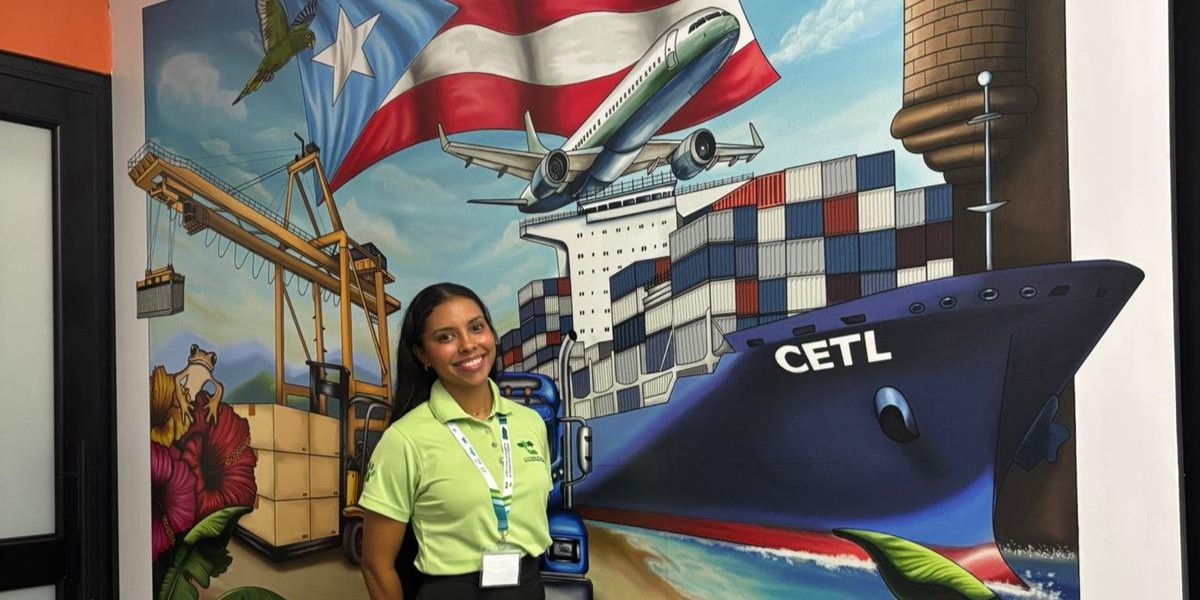
Every visitor who walks into the Center of Excellence for Transportation and Logistics (CETL) at the University of Puerto Rico at Mayagüez (UPRM) is greeted by a mural. Under a waving Puerto Rican flag, a gantry crane lifts a container, a forklift moves pallets, a blue truck rolls toward the viewer, a plane takes off, and a container ship bearing the CETL name sits ready at the dock. The mural was not outsourced by a professional artist, it was designed by one of the Center’s own graduate students, who had never made a mural or a digital design before.
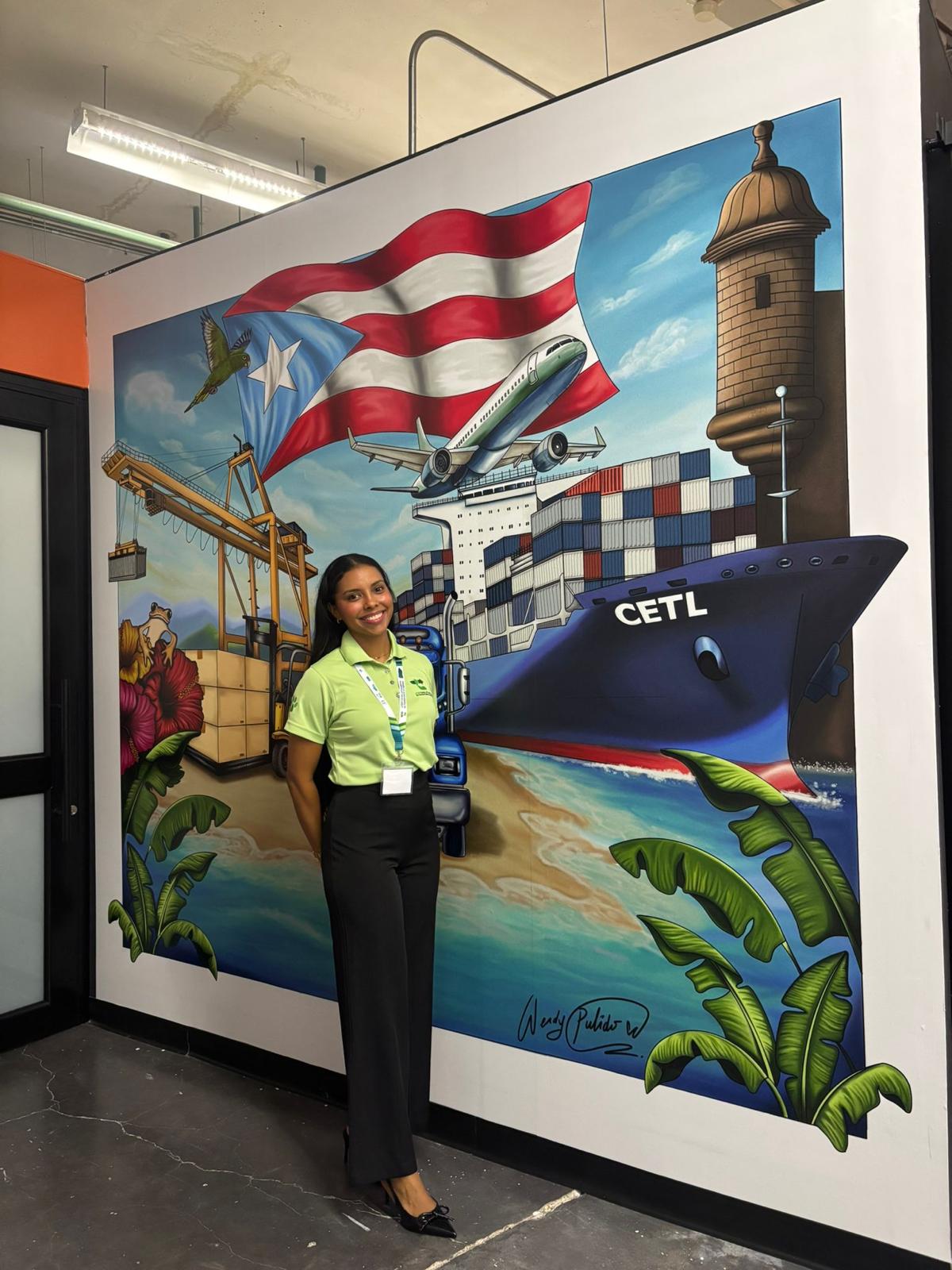 Graduate student Wendy Pulido with the mural she designed for CETL’s September 2025 inauguration.
Wendy Pulido, a master’s student in Industrial Engineering from Colombia, started working with Dr. Héctor J. Carlo, CETL’s Principal Investigator, and Dr. Daniel Rodríguez Román of the Department of Civil Engineering. Wendy had never shared with them that she draws, paints and designs in her free time. So, when Saltchuk’s team, CETL’s founding sponsor, asked for a wall art for the new Center, it was a fellow graduate student and Wendy’s first Puerto Rican friend on the island, Carolina Arroyo, who suggested her to Dr. Carlo.
For Dr. Carlo, the request was an opportunity. “CETL’s focus is Puerto Rico, so the space had to carry a message of identity: that we are the ones responsible for the future of transportation and logistics in Puerto Rico”, he said. “The mural showcases that identity”.
Pulido was a natural fit for the assignment, an international student who had recently arrived on the island and was specializing in transportation and logistics. “Logistics and Puerto Rico were the two major topics she was learning as part of her master’s degree”, Carlo said.
A Six-Week Deadline
With about a month and a half to go before the inauguration, Dr. Carlo shared Saltchuk’s request and the team’s ideas for the space to Wendy. Within a week, Pulido had a first draft. Saltchuk and the CETL team loved it and asked for only minor changes, which she worked on while making sure the colors and elements truly represented the island and connected with transportation and logistics. From the very first conversation to the final design took about three weeks.
“A week before I started this project, I had bought a tablet to take notes for my classes”, Pulido said. “I never imagined I would end up using it to design a mural of that size”. It was her first mural project and her first digital design for CETL.
From Lines to Color
Pulido first designed the mural in a wide, rectangular format, because the team expected it to go on a structure shaped like a shipping container. Once the final wall was chosen and measured, she resized the canvas and rearranged every element into a squarer composition.
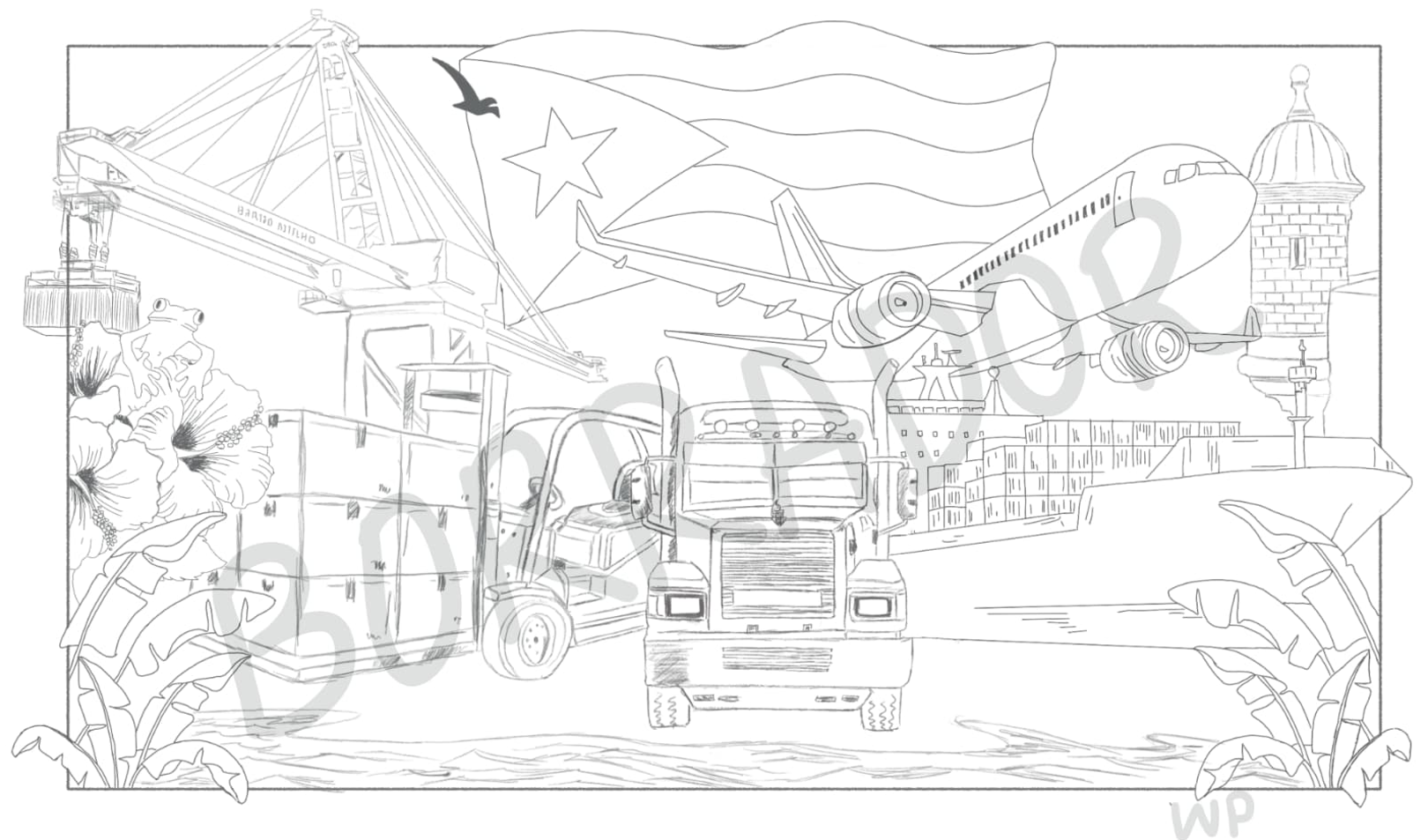 Pulido’s first draft: line art in a wide, rectangular format. The final design became a squarer composition in full color.
Two Sides of One Island
Pulido built the mural around two ideas that complement each other. One is Puerto Rico’s culture and natural wealth which she projected through the coquí, the plantain plant, the beaches, and the flag. The other is the transportation that moves the goods that power the economy and reaches people across the island which she projected with the ship, the crane, the forklift, the truck, and the plane elements.
“After eight months in Puerto Rico, I had seen how much Boricuas love the coquí, the plantain plant, their beaches, and their flag”, she said. “Capturing that sense of belonging was essential for me. I wanted the mural to shout that this Center was from Puerto Rico to the world”.
One detail is easy to miss. Pulido drew a frame around the scene, and some elements broke out of it. Those are the means of transportation and logistics, which, in her words, carry Puerto Rican talent and the drive to develop the island “beyond the 100 by 35 miles”.
What does “100 x 35” mean?
Puerto Rico’s main island measures roughly 100 miles long by 35 miles wide, a figure Puerto Ricans often use as shorthand for the island itself. The mural’s message is that the island’s reach is not limited by its size.
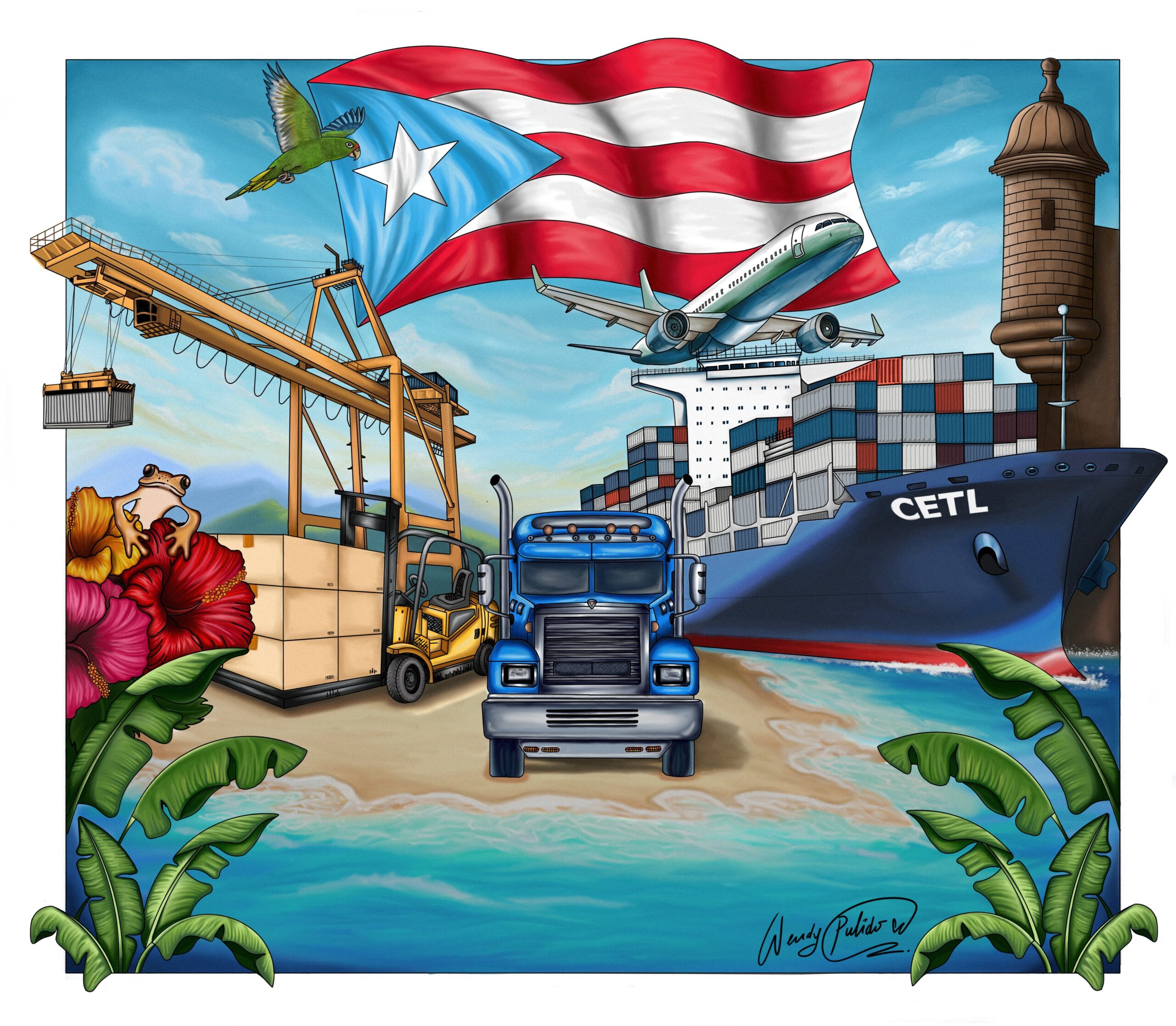 The original design for the CETL mural. Notice the elements that break out of the frame.
From Colombia to Mayagüez
Pulido was born in Bahía Málaga, in Buenaventura, on Colombia’s Pacific coast, a place of waterfalls, rivers, and untouched beaches. She grew up mostly in Soledad, Atlántico, on the country’s Caribbean coast. Growing up by the sea gave her a sense of familiarity with Puerto Rico before she ever arrived. That cultural closeness, along with friends’ strong reviews of UPRM’s professors and its focus on STEM innovation, brought her to Mayagüez.
“It was where I found the perfect balance between my plan to keep studying and preparing professionally, and the chance to do it somewhere that made me feel at home”, she said.
Where Art Meets Engineering
Pulido has no formal art training beyond school classes, but art runs in the family: her father is a musician, her grandfather played the saxophone, and all her siblings play at least one instrument. During the pandemic, she began painting acrylics on canvas as a hobby and sharing them on Instagram. Friends started commissioning pieces, and the hobby became a small business. Until the mural, though, every piece she had painted followed a client’s request. “Being asked to make a mural with complete creative freedom was really exciting”, she said.
A Gift for Every Guest
The design was so well received that it did not stay only on the wall. For the inauguration, it was reproduced as a limited edition of serigraph prints, each numbered and signed by hand by the artist, and given to the guests. Industry leaders, partners, and sponsors who attended took a piece of the Center home with them.
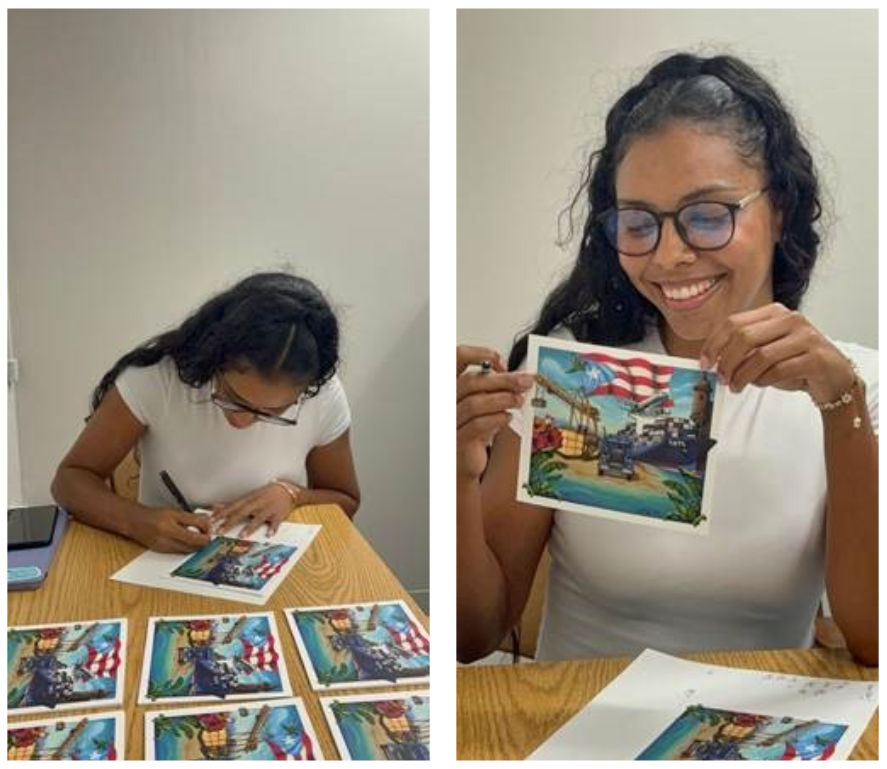 Moments when Pulido signs the limited-edition prints given to guests at CETL’s inauguration.
“They Think the Artist Is Boricua“
The largest canvas Pulido had painted in Colombia measured about 150 by 60 centimeters. The CETL mural is about 9’8″ x 9’1″. Seeing a design she had created for a country she had known for only nine months at that scale was, she said, “inevitably striking and moving”. Its placement makes it the first thing people see when they enter the Center.
What she enjoys most is people’s reaction. “In person and on social media, people have told me they think whoever made the mural is Boricua” she said. “That tells me I achieved my goal: to represent Puerto Rico in a way its people can identify with and recognize themselves in”.
Making the Island Her Own
Asked how a Colombian student came to call Puerto Rico “our island”, Pulido points to its people and their resilience: professors, friends, and strangers who welcomed her as an international student far from her family, and who remain committed to the island’s progress despite adversity.
That feeling also drives her research on the Freight Data Observatory, the project she was recruited for. The platform reconstructs how cargo moves across the island’s municipalities to support better decisions on infrastructure and freight transportation. She is the first author of a paper on this work accepted for presentation at the Transportation Research Board (TRB) Annual Meeting in January 2027. “Just as Puerto Rico has given me the opportunity to grow, I want my work to contribute to its future”, she said.
“When we submitted the proposal to create CETL, the one non-negotiable project for the country was a Puerto Rico freight data observatory”, Carlo said. Before her master’s, Pulido had worked in the logistics industry for several years, and she also stood out in his Mathematical Models in Distribution and Logistics course. “It was the perfect time and place”, he said. “Seeing how good she was, we recruited her as CETL’s first graduate student”.
A Vision on the Wall
CETL was created in 2025 with a 10-year, $10 million investment from Saltchuk Resources and broad industry engagement, and it is the first center of its kind in the Caribbean.
“You walked in through the container door, and the mural welcomed you. It looked spectacular”, Carlo said. “It gave us identity. People would tour CETL and then come back to see it one more time”.
So, what should an industry leader think the first time they see the mural?
“That Puerto Rico is the cherry on top”, Pulido joked. Then, more seriously: “That CETL is the ideal space to develop their ideas hand in hand with Puerto Rico’s best talent, where academia, industry, and Puerto Rican talent come together to turn knowledge into solutions that reach beyond the island’s borders”.
“This mural represents a vision”, she said. “The potential of an island is not measured only by its geography, but by its people’s ability to create, innovate, and open paths toward the future”.
Want to see the mural in person or learn how your organization can collaborate with CETL? Contact us at cetl@uprm.edu or visit uprm.edu/cetl.