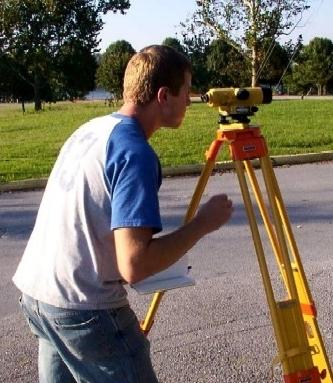
The laboratory houses instruments representing different generations and technological levels, enabling students to understand both fundamental measurement principles and modern automated data collection methods.
Available equipment includes:
- Automatic levels
- Digital levels
- Laser levels
- Digital theodolites
- Conventional total stations
- Robotic total stations
- Scanning-capable surveying equipment
- Data collectors
- Field accessories and auxiliary equipment required for surveying exercises
These instruments support activities related to leveling, angular measurements, electronic distance measurements, topographic surveys, establishment and verification of control, construction staking, automated data acquisition, and other operations commonly performed in professional surveying practice.
Satellite Surveying Equipment
The laboratory is equipped with GNSS (Global Navigation Satellite Systems) receivers and the accessories required to perform positioning exercises and satellite-based surveys.
These resources allow students to gain experience in:
- GNSS observation planning
- GNSS surveying and control establishment
- Static and kinematic positioning methods, depending on equipment capabilities
- Observation acquisition and transfer
- GNSS data processing
- Evaluation and analysis of results
- Integration of GNSS coordinates with other surveying and geomatics data
Access to this technology enables students to connect geodetic and coordinate system fundamentals with modern positioning procedures used in professional practice.
Computing Resources and Specialized Software
The laboratory provides access to software used for design, surveying, observation processing, and geospatial information management, including:
- AutoCAD and associated applications
- Carlson Civil Suite
- ArcGIS Pro
- Trimble Business Center (TBC)
- Mobile Device Center for communication and data transfer with field data collectors
- Software associated with total stations and other terrestrial surveying instruments
- Specialized software for GNSS observation acquisition and processing
These resources allow students to complete the entire workflow from field data acquisition to final technical product generation.
Plan and Cartographic Product Production
The laboratory includes a large-format HP plotter available for student use.
This resource allows students to produce plans, maps, graphics, and other technical documents derived from coursework and academic projects.
The availability of large-format printing equipment complements the educational process by enabling students to develop products similar to those used in professional practice.
Learning Experiences and Competencies Developed
The combination of field instruments, GNSS equipment, and specialized software allows students to develop experience in:
- Survey planning
- Appropriate selection of instruments and measurement methods
- Operation of surveying instruments
- Systematic field data acquisition
- GNSS positioning
- Digital data transfer and management
- Processing and adjustment of observations
- Evaluation of data quality and consistency
- Management of coordinate systems and geospatial information
- CAD-based plan preparation
- GIS analysis and cartographic production
- Integration of multiple geospatial data sources
- Preparation and presentation of technical products
- Individual and team-based work during field and laboratory activities
These activities provide practical experiences that contribute to the development of technical knowledge and skills required in the surveying and geomatics profession.
Relationship to Student Outcomes
Laboratory resources provide opportunities to support and assess several of the program’s Student Outcomes, particularly those related to the application of technical knowledge, problem solving, experimentation and data analysis, use of modern disciplinary tools, technical communication, and teamwork.
For example, field exercises require students to plan procedures, select instruments, perform observations, evaluate data quality, and produce technically defensible results.
Similarly, processing activities utilizing CAD, GIS, and specialized software allow students to integrate observations from different technologies and transform field-acquired data into information and products used in professional practice.
The specific relationship between each course, laboratory activity, and Student Outcome is documented through the assessment mechanisms established by the Program.
Support for Projects, Research, and Academic Activities
In addition to activities directly associated with coursework, laboratory resources are available to support:
- Student projects
- Academic activities
- Research projects
- Instructional activities
- Fieldwork
- Development of maps and geospatial products
- Interdisciplinary and institutional collaborations
This availability expands students’ opportunities to apply their knowledge beyond individual laboratory exercises and participate in projects of greater scope and complexity.
Professional and Institutional Collaborations
The Laboratory and the Surveying and Geomatics Program have participated in projects and collaborations with other units of the University of Puerto Rico and with governmental agencies.
The Program has also maintained an established collaboration since 2000 with the Surveyors Institute of the Puerto Rico College of Engineers and Surveyors (CIAPR) and maintains academic and professional connections with the International Federation of Surveyors (FIG).
These relationships help maintain contact with professional practice and provide opportunities for academic, technical, and professional development activities.
Summary of Resources and Their Contributions to the Program
- Automatic, Digital, and Laser Levels
Primary Academic Use: Leveling and elevation determination
Contribution to Learning: Measurement, vertical control, and evaluation of observations
Primary Academic Use: Angular measurements
Contribution to Learning: Fundamentals of surveying observations and field procedures
Primary Academic Use: Surveying and construction staking
Contribution to Learning: Integration of angle, distance, and coordinate measurements
- Robotic Total Stations and Scanning Equipment
Primary Academic Use: Automated spatial data acquisition
Contribution to Learning: Exposure to modern surveying technologies
Primary Academic Use: Positioning and control establishment
Contribution to Learning: Coordinate systems, geodesy, and satellite positioning
Primary Academic Use: Digital observation acquisition
Contribution to Learning: Field data management and transfer
Primary Academic Use: Plan preparation
Contribution to Learning: Graphical representation and technical communication
Primary Academic Use: Surveying and design
Contribution to Learning: Processing and production of topographic information
Primary Academic Use: GIS and cartography
Contribution to Learning: Analysis, integration, and visualization of geospatial information
Primary Academic Use: Observation processing
Contribution to Learning: Processing, integration, and evaluation of survey data
Primary Academic Use: Production of plans and maps
Contribution to Learning: Presentation and communication of technical results
Adequacy of Facilities
The Surveying and Geomatics Laboratory provides the space, instruments, equipment, and computing resources necessary to support the practical activities of the courses that utilize the facility.
The combination of terrestrial instrumentation, GNSS technology, digital data acquisition, CAD, GIS, and specialized processing software allows students to experience a workflow representative of contemporary surveying and geomatics practice:
Planning → Measurement and Data Acquisition → Data Transfer → Processing and Analysis → Evaluation of Results → Preparation of Plans and Maps → Presentation of the Final Technical Product.