
The Department of Chemical Engineering (INQU) at the University of Puerto Rico at Mayagüez proudly congratulates Dr. Claribel Acevedo-Vélez and Dr. Magda Latorre-Esteves on their selection for the 2026 Advanced Research Grant – Space Edition from the Puerto Rico Science, Technology & Research Trust (PRSTRT).
Both professors were among seven researchers selected across Puerto Rico to advance innovative research through experiments aboard the International Space Station (ISS).
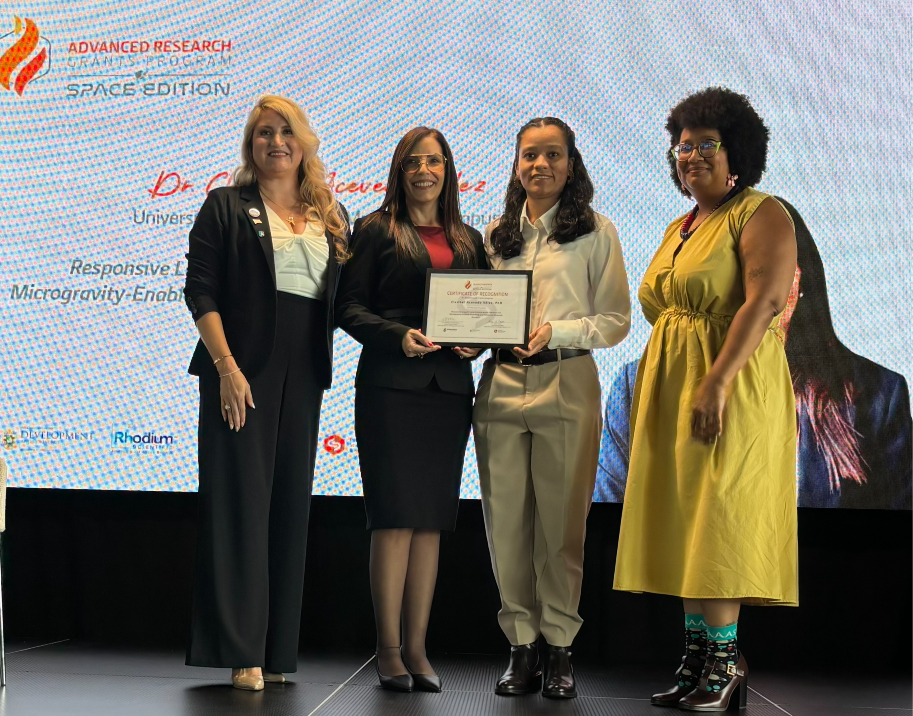
Dr. Claribel Acevedo-Vélez: Advancing Liquid Crystal Biosensors in Microgravity
Project: Responsive Liquid Crystal Droplet-based Platforms for Microgravity-Enabled Biosensing and Advanced Materials Research
Dr. Claribel Acevedo-Vélez’s research group develops microscopic droplets of liquid crystal, the same class of materials found in phone and television screens, that change their optical pattern when they encounter specific molecules. These droplets can detect components of the bacterial cell wall that are associated with fever, inflammation, and septic shock. The droplets are stabilized using a patented platform based on silica nanoparticles and surfactants, of which Dr. Acevedo-Vélez is a co-inventor.
With support from the ARG Space award, the team will send these droplets to the International Space Station. On Earth, gravity constantly disturbs how the droplets and their nanoparticle coatings organize. In microgravity, the team can study these materials without that effect for the first time. Sealed samples will fly to the Space Station while identical samples remain on Earth as controls. After their return, the samples will be analyzed at UPRM and compared side by side.
Impact on INQU and Puerto Rico
The project gives Chemical Engineering students direct experience with space-based research, from experiment design and sample preparation to post-flight analysis. Doctoral student Maria Karla Oñate will work on the project alongside Dr. Acevedo-Vélez. The experiment was designed in Puerto Rico and will be prepared and analyzed at UPRM, which strengthens the island’s growing presence in space research and builds partnerships with the commercial space sector.
The results will contribute to simple, low-cost sensors that can potentially monitor astronaut health and water quality in space. On Earth, the same technology could help detect contamination in hospitals, in pharmaceutical manufacturing, which is a cornerstone of Puerto Rico’s economy, and in communities with limited access to advanced laboratories.
Dr. Magda Latorre-Esteves: Exploring Cellular Adaptation in Space
Project: Microgravity-Induced Cellular Adaptation in Saccharomyces cerevisiae: Persistence, Mechanisms, and Biotechnological Relevance
Dr. Latorre-Esteves will investigate whether yeast cells develop stable cellular adaptations following exposure to space conditions.
By studying how Saccharomyces cerevisiae responds to the space environment, the project aims to advance our understanding of cellular adaptation and potentially support the development of more resilient yeast strains for industrial biotechnology and biopharmaceutical manufacturing.
Strengthening Puerto Rico’s Presence in Space Research
These awards highlight the contributions of INQU faculty to emerging areas of space science, biosensing, advanced materials, and biotechnology. The projects will also create opportunities for scientific collaboration and strengthen Puerto Rico’s participation in space-based research.
Congratulations to Dr. Acevedo-Vélez, Dr. Latorre-Esteves, and their research teams on this outstanding achievement!