Sandy Feinstein
Remembering Syria
Tinta regada
12 – octubre de 2026
…the images she sent through Facebook became increasingly of distressed humans, mostly women and children, what have become
stock images of a country ravaged.
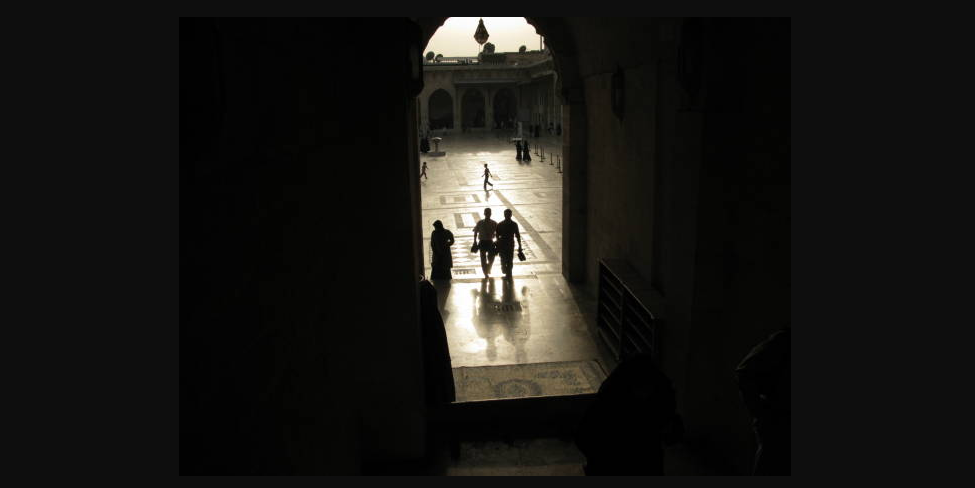
***I can’t recognize Aleppo in the news. When I hear the names of places I knew, my knee jerk reaction is to re-pronounce their names, Homs, the “s” like a hiss, the emphasis hard on the breathy “H”; Hama, a doctor’s “Ah, ah,” slight stress on the first syllable. The Arabic I learned has been reduced to sounds: always recognized when heard, but no longer placed by country.
The Halab I recognize, that seems to elude reporters, is the one my former students write about on Facebook. They agree about nothing. The two who post the most, a Christian male living in Southern California and a Moslem female in Tennessee, express opposite viewpoints. To Tony, Hilary Clinton’s intention of bombing Syria nearly ten years ago was an act of unjustified aggression; to Nour, the lack of military support was a betrayal of the country. Their opinions on Iran now seem to be reversed.
As an undergraduate at the University of Aleppo, Tony wanted—still does—to be a rock star. Then he’d show me lyrics, hum a few bars; now he posts YouTube videos of himself performing. The last time we met to talk about his lyrics was just before I returned to the United States after my Fulbright year in 1999. We sat in a new coffeehouse, all blond wood and the best cappuccino in town, not to mention toilets combining the best of the east and the west, hand bidets and flushing.
Nour won the prize for best essay written in English. I have a picture of us in Damascus where she received the award given to her by then ambassador Ryan Crocker, once an English major himself. I had been to her home. She always wore the hijab and still does in the United States. She also wore a long brown coat like an abaya. At the time, she was ranting about Turkey, specifically its Ottoman legacy of secularism, a heritage she had no way of knowing I benefited from on my mother’s side. Times have changed.
Etymologically, my family shares the name of the Assad family, Syria’s powerful presidents since 1971. His name means “lion,” so I was told. My mother’s maiden name, “Aslan,” appears in the Narnia Chronicles by C. S. Lewis and also means “Lion,” which I have known since I was a child, well before I ever heard of Narnia, and well before I recognized the allegory of the story.
When I got to Syria, I would proudly announce my connection to the region by mentioning my mother’s maiden name. While “Feinstein,” my father’s name, registered recognition of my religious origins when I had a Fulbright in Denmark, as it would in New York where I grew up, it meant nothing in Syria. But Aslan meant far more than lion, as I was to learn when a colleague’s husband asked where my mother’s family was from, and I said, “Baghdad.” To which he replied, “Oh, so you’re Jewish.” At my shock, he added, “in Aleppo, you would be Christian—I’ll show you a marquee with your name—and in Latakia you would be Moslem, or, Alawite, like our President.” That was the last time I told anyone my mother’s maiden name.
So far as I know, my Syrian students and colleagues, as well as most of my Middle Eastern friends, had no idea I was Jewish. I would learn, though, it was better to be Jewish than atheist, better to be unable to have children, then to make the decision not to have them.
Few of my former Syrian students are Facebook friends with one another, though many were in the same huge American literature class I taught, which was not then, or now, my field. Officially, there were hundreds enrolled; in fact, fewer than half of those enrolled showed up. Many lived outside the country and relied on the notes that could be bought at the bookstore; UCLA, where I taught for two years, had a similar practice of offering professional notes at the bookstore.
The first electronic message I got from Nour caught me up on her life: she said I might be surprised to learn that she had married a man living in America, had had a child, and was back in Syria. She offered no explanation, and I didn’t ask for any.
As an undergraduate she was determined to get out of Syria; to do that, girls married men residing elsewhere, preferably in the United States, followed by France, Germany, and the Gulf States. When I next heard from her, she had returned to the States.
The gist of her message nearly a decade ago was a cri de couer that felt like an accusation: she sent a picture of Aleppo’s Citadel, recalling, she said, how much I loved the imposing fortress near the Old City. I’m not sure how she knew—whether I had told the class or she’d heard a poem about it that I’d read aloud at a local poetry reading.
The Citadel had been bombed. Its tower beheaded, the area strewn with rubble where I had once ridden a donkey, an indulgence offered by a young boy. Nour did not try to elicit any sympathy for my former students or my friends. Later, the images she sent through Facebook became increasingly of distressed humans, mostly women and children, what have become stock images of a country ravaged. She did not send any pictures of Palmyra’s destruction—Tadmor—whose enemies were not the government.
Tony, employed in Southern California, did not personalize his political statements. He ranted about what he felt the U.S. government does not know, what has been misrepresented, what has not been written. Appearing on his Facebook page ten years ago come mid-December was this comment: “And who appointed us to judge what’s right and wrong! We have the bloodiest track record. We say it’s for the people, but make no mistake, we’re making a huge profit at the cost of hundred thousands of people’s lives. Name one Syrian who is happier today than he/she was five years ago. Had we not interfered, the whole thing would have lasted a few months.” “We,” are Americans, and he identifies himself in that we. Much has changed since then. Assad is in exile. Iran has been bombed.
I know that two of my graduate students are no longer in Syria—one is teaching in Dubai; the other reinvented himself in the United States. I had helped Rabia get into a Kansas graduate program in English with full funding; but he doesn’t teach English or Arabic. From his Facebook posts, it seems he hikes a lot; I think he works in a STEM field, like Tony, who was also an English major.
I don’t know if my former students, a diaspora of the educated—I also taught in Bulgaria after the Velvet Revolution—can see one another’s posts by way of my home page. If they can, they ignore them.
A Syrian’s future career was determined by a test in high school. I don’t know whether this has changed. I doubt it. The lowest “passing” score allowed for higher education in English; the highest scores meant admission to the comparatively more lucrative fields of medicine and architecture. Syrians became doctors and architects no matter their interests or predispositions. They were artists and translators in their spare time. When asked once for a book to translate into Arabic by one of my physician friends, now relocated in the U.S., I suggested All the Pretty Horses by Cormac McCartney, a story of a boy who leaves a threatened home, encounters violence on his journeys, a loss of innocence and things. I haven’t heard from my physician friends since they moved to the States.
On occasion, Tony shares a feed about refugees, the ones you’ve seen: thousands packed into camps, in rags of what’s left to them. So many, like Nour and Tony, were emigrants well before there was a war.
The former students I most fear for are those who stayed–and those who may now be expelled from the United States after the Supreme Court’s latest decision regarding temporary protected status for Syrians and Haitians. Even during the most dangerous of times, some have posted—during war, after regime change. When I lived and taught in Aleppo at the end of the last century, the internet was not available to most. Those with e-mail addresses were connected through Lebanon. I had access to the new university computer to teach select administrators how to navigate the internet.
I haven’t heard lately from either of what were my two most regular correspondents from Syria, one a former graduate student, the other an undergraduate. Abdul Rahman engaged me regularly in conversation and as regularly sent e-mail messages and later Facebook messages. Five years ago, he was desperate, and, like Nour, his communication implicitly assumed I had power to do something for his family, if not for him: a visa to the United States.
Though he could not know his approach made me cringe—referring to me as his children’s grandparent—I did write the embassy in Beirut. Nothing came of it. All the embassy staff once in Damascus had long since been reassigned. There were no State Department staff left in Syria, no Embassy. I had known people at the State Department because the Fulbright in Syria was administered by the now defunct USIA, or United States Information Agency, and we had orientation with State Department staff as well as invitations to embassy functions. Even then, we had no power.
If Abdul Rahman’s last post is up-to-date, he made it to Turkey—though I haven’t heard from him since my letter to the embassy was ineffectual.
I took 11 students to Turkey in 2013, hoping to see Fuad, who could have been one of my students if he’d passed his exams, or had the right connections. When he wasn’t working, he taught himself English and Turkish from television programs in those languages.
I met Fuad when trying to find my way home from an outdoor swimming pool; I had been in the country one week. He stopped his car when he saw me struggling to ask a couple where the mosque with two minarets was. They were patient while smiling with incomprehension; they had no idea what I was asking. Fuad is blond, then with a buzz cut, and there was a covered woman sitting with him in the front seat. I repeated my question in my made up Arabic. He said he spoke English, so I asked him, “Where is the mosque with two minarets?” He didn’t laugh. He didn’t say there are more than 80 such mosques in the region. Instead, he suggested I get in the car, and he would take me to a mosque with two minarets, and I could tell him if it was the right one. When I automatically got in, I wasn’t thinking about what my father said before I left: “Safest country you could be in. Something will only happen, if the government wants it to.”
On the very short ride to “my mosque,” I would learn that the woman in the front seat was his sister; she was studying English at the university and said nothing. She would later marry a doctor in New Jersey. Quite by accident, I would meet her brother Fuad again, this time driving alone in our neighborhood of elegant pale white marble and limestone buildings. After calling hello, he idled his car and asked if I jog. I looked surprised and asked how he knew. Having first met me with wet hair, walking from a swimming pool, he said, “You swim. You’re American. I assume you probably jog, too. Right?” When I sounded skeptical about jogging in Aleppo, he said he’d pick me up the next morning to jog. He arrived in his blue Saab at 7:00 a.m. the next morning and drove to Sabil Park, where we jogged that morning and every morning thereafter for nearly a year. The park was crowded with joggers and walkers of all ages. I was in my late forties; Fuad was in his early twenties. He told me about the old ladies commenting on my speed and endurance. No one, male or female, wore shorts or sleeveless tops.
Ambassador Crocker jogged on Damascus streets at 5:00 in the morning, with a detail of security.
I would spend a lot of time with Fuad and his family. He also had a brother, Fadi. I remember him baking something, then joining us and exclaiming that he wanted to be a chef. He was a child then. I learned he went to Jordan to study, though I can’t recall what subject, or why he left the country for his education. I knew many students who did the same, and even more who wanted to. In a Facebook post in 2013, as I made plans for my course in Turkey, I learned Fadi was fatally shot in Aleppo.
With his sister and uncle in the U.S., his brother in Turkey, and his parents in Egypt, I could not imagine Fadi as a “rebel” or “radical.” Assad was opposed by many for many reasons. When I was there, no one would talk about why in any language. And I never asked. Fuad wasn’t in Turkey when I visited; he was with his parents mourning Fadi in Egypt.
Now I think of the duck blood I dripped in Aleppo as an omen. Never mind the context, a celebration of my birthday—my sister visiting and intent on making me my favorite food, as she often did for my birthday. To find a duck, we asked around and were directed to a small yard with all kinds of fowl running loose, some pecking at strewn seeds. My sister refused to pick the duck to die. A French friend, from a family of chefs, chose matter-of-factly and watched the proprietor kill and prepare the bird. I carried it in a plastic bag to the coffee house, set it on the floor, and, after we’d finished our cappuccinos and lattes, picked up the bag to leave. A pool of its draining dark juices had puddled.
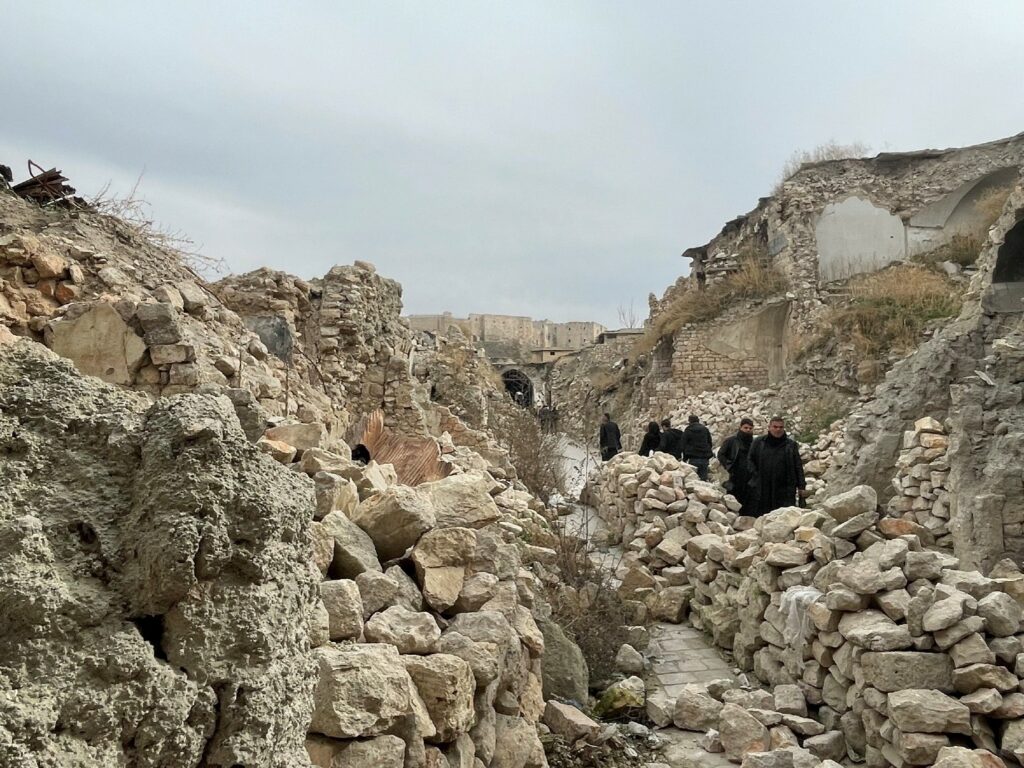
The last pictures of Aleppo sent to me showed the old markets leveled. Piles of rubble. Nothing recognizable. Nothing familiar. Too much buried. Too much blood drawn.
Photo of Aleppo by Abdul Aziz Hallaj, sent to the author February 3, 2025.