
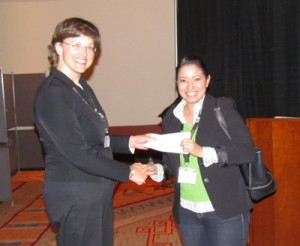
PhD Student Darlene I. Santiago Quiñonez Wins First Place in Society of Rheology Annual Meeting Poster Competition

Doctoral degree candidate Darlene I. Santiago Quiñonez won first place in the Poster Competition held in this year’s annual meeting of the Society of Rheology, held October 24-28, 2010, in Santa Fe, New Mexico. Darlene presented a poster entitled “Rheological Characterization of a Ferrofluid Consisting of Permanently Magnetized Nanoparticles,” which describes par of her dissertation…

Details

Como presentar un trabajo oral exitoso

Una parte importante de la actividad científica consiste en comunicar los proyectos y resultados tanto en forma escrita como oral. A diferencia de las comunicaciones escritas, los que escuchan una charla solo tienen una oportunidad para entender y no pueden releer si se pierden. Es muy importante preparar las charlas cuidadosamente haciendo hincapié en la…

Details

Thermoforesis and Possible Applications

Thermoforesis is a phenomenon that can expand new horizons of what the not too distant future there is the possibility of building machines and nano-scale structures. That is why the importance for engineers and scientist to know how these models behave. In other words it you understand their behavior and properties of these nano machines…

Details

Something about Janus particles

The word Janus has its origin in the Roman god Janus. In Roman mythology this was the god of the gates, doors, doorways, beginning and endings; who is depicted with a double-faced head, each looking in opposite directions. Thus, in nature and materials science, asymmetric particles with two incompatible sides are called Janus particles. The…

Details

Common Mistakes in Research Papers

Some people have several errors before submit a paper, especially, if is not their native language. This list contains some common errors to take into consideration. Verb tense: As a rule, use past tense to describe events that have happened. Such as, procedures and results that you have obtained. Reference to results should be in…

Details

Two-faced Janus Particles

A Janus particle is composed of two fused parts, two-faced, like the Roman god Janus of doorways who is usually depicted with his faces looking in opposite directions. These asymmetric particles have two distinctly different sides, i.e. each face made from a different surface chemistry, or substance, than the other one. This kind of particles…

Details