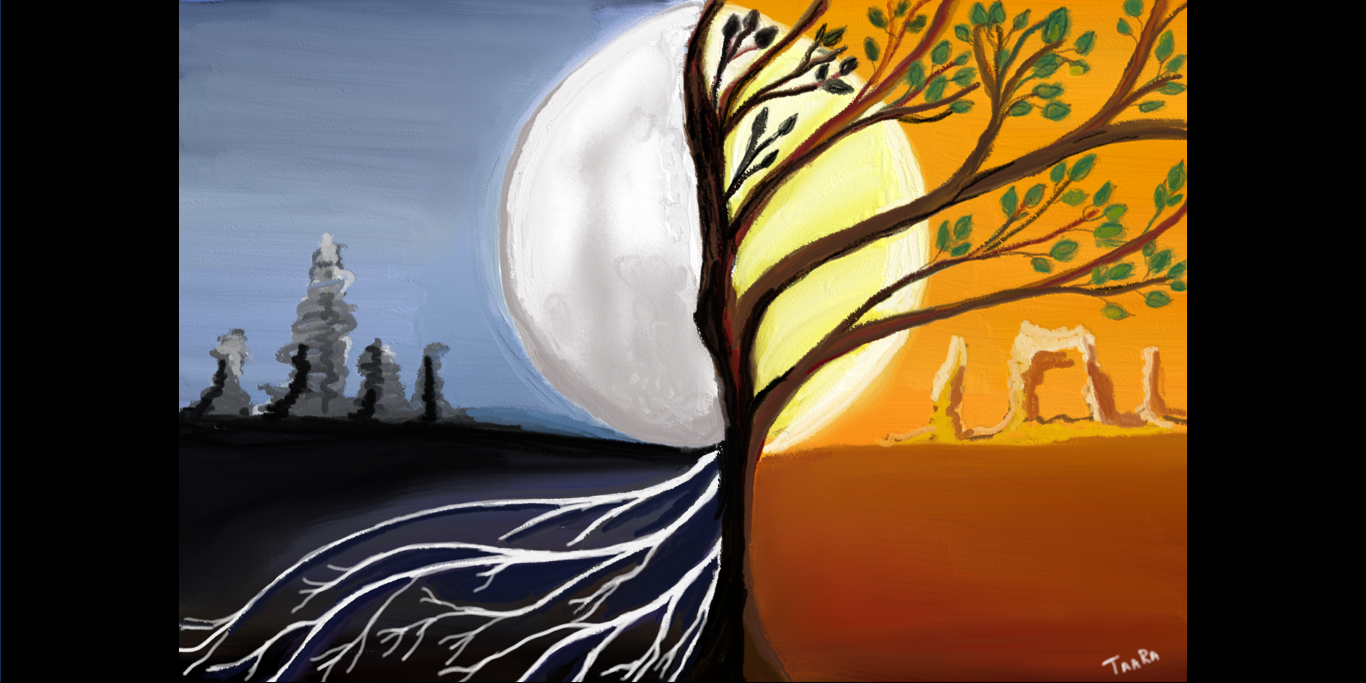
Taara
A Half-Eaten Moon and The Cloud Monsters
Tinta regada
9 – enero de 2026
Ira had never travelled in her life. The farthest she had gone was to attend a wedding at Mewar Gunj, a hundred kilometres away from her grandfather’s Palladian mansion in Barmer.
As a child, she played in the portico, pretending the pillars were the Andes Mountains and the courtyard fountain the Pacific Ocean. She knew she would never see the real Andes or the Pacific.
Ira’s mother had been an avid traveller, blessed with her father’s money and plenty of time to explore the world. But during one of her journeys in the mountains of Sandakphu, she met Ira’s father, a prospectless actor, and eloped with him. Seven years later, she returned home to Barmer, heartbroken. Her husband had left her for another woman, abandoning her with a five-year-old daughter. Soon after, Ira’s mother died too.
Ira’s grandfather never forgave his daughter’s “foolish choices.” Believing travel to be the root cause of her ruin, he banned it from his granddaughter’s life.
Despite her secret desire to see the Andes and the Pacific, Ira was convinced her grandfather was right. When he died at ninety-seven, leaving her the sole heiress of his property and custodian of her own life, Ira still refused to travel. After three decades of constant indoctrination, she could do little else. All she had learned was self-preservation. Yet sometimes, gazing at the shifting waves of starlight on the distant horizon, she asked herself: if she could not explore even one planet among these zillions of galaxies, why preserve life at all?
Her thoughts grew dark, as if she were caged—not in gold, but in diamonds—its dazzle blinding her to reality. A secret call rose in her heart, a summons to break free, but she silenced it. Afraid she was betraying the very ones who had cared for her since childhood, she locked herself further within. Still, a part of her always searched for a way out.
Ira kept her mother’s memory alive through rare artefacts collected from across the world. Since she could not travel, she grew the collection by other means. She bought items online—a sahumador from Peru, a chandelier from Türkiye—subscribed to journals announcing new finds, and joined communities of antique lovers to discuss and evaluate objects.
One day, she received an email from “SAlvador117,” a member of one such group. Attached was a forwarded image Ira had once shared: a bronze medallion with a gem-encrusted Tree of Life, its lower part missing. It was a souvenir from Vietnam, a gift from her mother.
The email contained just three lines: “Do you still have it with you? I want to buy it. Name your price.”
Such requests from one antique lover to another were not uncommon, but Ira politely declined. Within three minutes came a reply: “Please. I need it very badly. I am ready to offer a hundred thousand dollars.”
The sum was absurd for a bronze medallion. Suspicious, Ira ignored it. Another message arrived: “Two hundred thousand?”
Intrigued now, she asked: “Why do you need it so desperately?”
The reply did not come instantly. When it came, it was a bit longer than the previous one-liners and more cryptic in nature: “One half of the medallion is with me. I need the other half to answer the most fundamental question of life.”
“What question? What answer?” Ira wrote back. But there was no response. She waited for hours, then went to seek the answer herself. She took out the medallion.
At first glance, it looked ordinary—barely a century old, a semicircular disc like a half-eaten moon with an uneven inner arc, meant to hinge with its missing half. The front bore black tourmalines and a quartz crystal, enmeshed in the copper branches of the Tree of Life. On the back, in Roman letters, were the words: “The Way Out Is…” The rest was missing.
“It must be in the other part,” Ira thought.
The words cast a spell on her. For the first time, she felt she had found her long-sought way out. Now she needed the other half even more than Salvador did.
She wrote: “How do I know you’re real? I want a video call.” She added her number.
The phone rang instantly: “Number Unknown”. Ira picked up.
Onscreen appeared a chiseled-jawed and olive-eyed man of forty. Something stirred deep inside Ira’s diaphragm, a feeling she had never known before—as though the undeniable final summon.
“Hi, I’m Salvador. You wanted to talk?” His voice carried a Mediterranean accent, rippling with urgency.
“Yes,” Ira said, unsure of her next words. After hesitation, she asked, “Can you show me the other half?”
Salvador studied her, as though trying to measure her earnestness, then reluctantly opened a wooden box. Taking the medallion out, careful not to reveal its backside, he held it forward before the camera.
The medallion half was a mirror to Ira’s. Its Tree of Life bore white stones, except for a single black crystal.
“Does it also have a message?” she asked.
He nodded.
“What does it say?”
Salvador looked suspicious. He countered, “You tell first.”
“No. If you want the other half, no negotiations.”
Salvador shook his head forcefully. “What if after learning my messaggio, you rifiutare… you may refuse to show yours.”
“That you have to trust.”
“So you too.”
They argued back and forth, locked in a stalemate of trust. Finally, Salvador threw up his hands. “Bene. You don’t show, I don’t show. I go to Vietnam and find out the segreto.” He disconnected.
Ira sat long with the medallion in her hand, turning its cold metal surface warm and sweaty. Then, she gave up. “What it is, let it be. I don’t want to know.” She put the medallion back and tried to forget it.
But the black tourmalines and the unfinished phrase “The Way Out Is…” gnawed at her like an uneven book on a shelf before someone with OCD.
At last, she went to her grandfather’s room. His portrait stared down at her, eyes stern even in kindness. Behind him, generations of ancestors seemed to glare in disapproval. Ira was about to shame her family.
Through tears, Ira whispered, “I’m sorry, Dada. I must travel, just this once. I must find the segreto.” She nodded, granting herself permission on behalf of her grandfather and all the dead ancestors.
The islands of Ha Long Bay were like emerald embellishments on a teal blue gossamer. The limestone cliffs, girdled with dense green foliage, stood at a strategic distance from one another—distant enough to complement, and close enough to support. Their shadows leaped in the water like dancing mermaids. But nothing pleased Ira’s unaccustomed eyes. She looked around, holding her backpack tightly to her chest. Every eye looked suspicious, every face was plotting malice.
The ship halted. It would not go any deeper. Beyond lay tricky canals navigable only by dinghy. The dinghy was old, a wartime memorabilia from the 1950s. Its worn-out wooden hull creaked at the slightest touch of the wave.
Both the dinghy and the ship danced together an arrhythmic dance, bobbing in the sea wind and never synchronising with each other’s moves. It made shifting from one vessel to another difficult. Looking at the protesting current underneath, Ira shuddered in fear. What if she fell? What if she failed?
Ira stood, clutching her bag to her chest even tighter, refusing to budge. The captain of the ship urged her to move on in some unintelligible language which scared Ira even more.
“Hold my hand.” A hand came forward, firm and confident, suntanned like the beaches of Stromboli.
Ira didn’t need to look up. “I was expecting you,” she said.
Salvador smiled, more handsome than on screen, if a little older. “So was I.”
They said nothing more as the boatman rowed, sitting at the helm, and the dinghy’s heart pounded faster with every sloshing stroke. Soon the dinghy entered a tunnel, naturally formed by the wind and the sea waves through millions of years. The darkness around became absolute, nothing could be seen, nothing could be heard except for the sloshing paddle strokes and the occasional sighs of each other. Nature’s acoustics created an illusion of an echo, amplifying the pitch-black silence. Ira inched closer to Salvador.
“Scared?” he whispered.
She nodded.
Even in that spotless darkness, Salvador could read her nod and said, “Me too.”
“Where are we going?” Ira asked, hesitant but also curious.
“I don’t know,” said Salvador. “No one knows until they arrive.”
Impatience flared in Ira. Being in the dark about the destination intensified the darkness around her. “Is it worth the journey?”
“The worth lies in the journey itself.”
“How long will the journey last? I feel choked.” She grew restless. Deep within her, fear was taking shapes like the monsters, formed in the shadow of the clouds—fangs, flames, and cruelty. Hiding her eyes, she cried, “I don’t want to see them! They promise happiness, then break your trust!”
Salvador held her. “They’re only shadows of your mind. Look again.”
Something in his voice gave her courage. She dared to trust and removed the cover from her eyes. Light shimmered at the tunnel’s end like the reflection of the rising sun. It flooded the water with its glow. The surrounding darkness was getting lighter. The unseen was now seen, the unknown started to reveal itself. Ira could see that the forms she once thought monsters were the stalactites and stalagmites in the water cave. As soon as she did so, their menace dissolved into beauty.
The dinghy drifted into a blue lagoon. Ira gasped, “Beautiful! I’ve never seen anything like this. Do you know, this is my first time travelling?” She spoke to Salvador, looking directly at him, happy that there was someone with her to share the joy of the first time.
“And all for the other half?” Salvador asked her, both curious and impressed, his olive-green eyes catching the teal blue hue of the surroundings.
She blushed, lowering her eyes. “I must know what the Way Out is.”
Salvador thought deeply before saying, “Do you know what my part of the medallion says?”
He brought out his half. Together they joined the medallion. The Tree of Life was now whole, its roots and branches balanced. A full moon with Yin and Yang sign. On the back, the complete message appeared in an endless loop:
“The Way Out is The Way In is The Way Out.”
They stared, stunned. They had expected that it would be something big, groundbreaking and time-changing, not a one-liner in a perennial loop. And to know it, they had to cross thousands of miles.
Salvador smiled dreamily, his eyes having the vision of a knower. “All my life I ran outward—from the Andes to the Pacific—searching for truth. But the way was always within.” He looked like a perfect moment—rare, as though one had caught a flock of birds crossing through the setting sun. His face drew closer to Ira’s. She could feel his breath upon her lips.
Ira wanted to say, “And all my life…” But her eyes opened. The limestone cliffs dissolved into bedposts and the drawn sun-blocking curtains. On her laptop, the Hanoi flight checkout still awaited.
After returning from her grandfather’s room, Ira had opened the computer to book the flight. But at the last minute, her heart froze, someone from inside had taken it hostage—someone who needed more than the approving nod from her grandfather and all the ancestors to let it go. Perhaps it was the cloud monster who was nothing but the stalactites and the stalagmites, but fearsome nevertheless. Ira could not muster the courage to complete the flight booking.
She did not know when she fell asleep, but now that her eyes opened, she could not sleep anymore. Ira had found the answer: The Way Out is The Way In is The Way Out—a message in a perennial loop. She did not need to travel anymore. Yet she decided to check out the booking because someone had said to her, “The worth lies in the journey itself.” But before that, she opened her email and typed a message to SAlvador117 to tell him what she could not finish telling before: “And all my life I feared the outside, because I had never dared to look within.”