Sejal Yadav
Me, or Someone I Haven’t Become Yet
Tinta regada
9 – enero de 2026
When I was eight, I found a reproduction of The Persistence of Memory tucked inside a frayed encyclopedia — one of those massive volumes too heavy for a child to carry, and too dangerous for a child like me to open. The clocks weren’t melting — they were dreaming themselves into entropy. The cliffs weren’t just Catalonia; they were the underside of my own skull.
I didn’t know it then, but I would spend decades inching toward that painting. Not walking. Not running. Inching, like the aftertaste of a dream, or a truth that forgets itself.
I booked a prepaid day trip with a company I’ll call The Soft Clock Express — a Julia-shaped fantasy that promised logic disguised as tourism. Girona by 9:30 am. The Dalí Museum by noon. Back in Barcelona before the earth remembers how to rotate. Time, dissected into digestible segments. Neat. Predictable. Sterilized. Antithetical to memory.
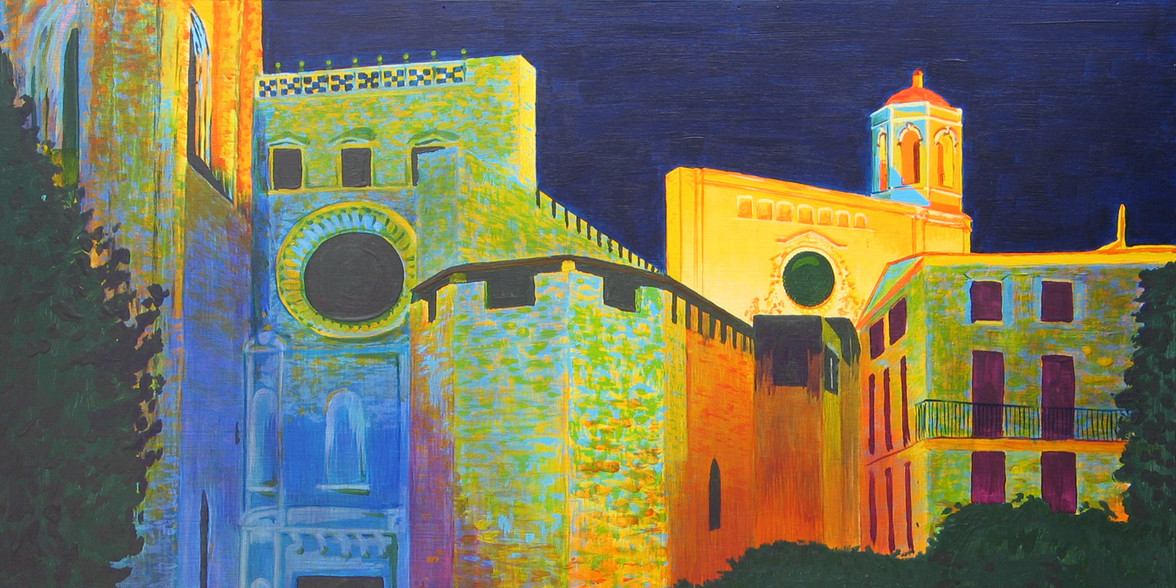
Girona welcomed me like a fresco — open-armed, ancient, patient. I did what one does in cities older than narrative: I rubbed the foot of Saint Narcissus’s fly for miracles, and the butt of the lioness for luck. I believed in both. I still believe in both. But miracles are mischievous, and luck doesn’t wear a watch.
I missed the tour bus by five minutes.
I didn’t panic. Not really. I stood in the plaza, the heat pushing against my neck, the sound of a fountain stuttering behind me. I stared at the space where the bus had been like it was an unanswered question on a philosophy exam. It felt like the second stanza of a dream I couldn’t finish. I was alone — or maybe just an unwritten page in someone else’s tour brochure.
That’s when my husband — my Gala, my quiet horologist of chaos — called from India. Calm. Clear. Thousands of kilometers away, coordinating with the tour operator, booking me a taxi, navigating me through a city I could not read. He wasn’t just solving logistics. He was stitching the narrative back together.
The cab ride to Figueres was green and deserted, lonely and lush, like life itself when you’re moving through it alone. Trees blurred past like unfinished sketches. Graffiti whispered Catalan prayers onto concrete walls — not slogans, but survival. A tongue still bruised from being silenced. Then came the flags — or maybe just their shadows. A Palestinian banner floated above a butcher shop, fluttering like a forgotten caption. A Pride sticker blinked from the edge of a drainpipe, half-peeled, like a mouth trying to speak underwater. Yellow ribbons looped around balconies. Purple ones dangled from laundry lines, damp with dew and prophecy.
They didn’t announce themselves. They weren’t aligned. Some shimmered with purpose. Others looked abandoned, ironic, lost in translation. Together, they formed a kind of ideological hallucination — beautiful, contradictory, uncaptioned.
A city dressed in unfinished thoughts. Every building a sentence missing its verb. Every window an opinion waiting to evaporate. Was this resistance? Or ornament? Or memory trying on costumes?
The professor in me began to catalogue. The traveller in me blinked. I watched the land slide by like a thesis unravelling — not disproved, just written in a language I no longer recognized.
And then: Figueres. Not a museum. A sovereign surrealist republic. A wound sewn in gold. I stepped into Dalí’s theatre, and everything stopped. The ceiling folded open like a pocket watch dropped into the sea. The Cadillac rained. A boat floated overhead, gently defying logic. Mirrors sighed. Velvet wept.
And above me — thighs ascending into infinity. Flesh as staircase. Body as cosmos. Dalí’s grammar of distortion made holy.
I tried to describe it to myself, to form a thought — but none came. Just a stillness. A hush. Like the space before breath. Time didn’t slow. It abandoned its job.
And there it was: The Persistence of Memory. Larger than myth. Hung not on a wall, but suspended in a breath. It wasn’t a painting. It was the reason I came.
I stood there. Then I wasn’t. Then I was many.
I saw every room, every whisper. I wept in the Mae West Room. I stared too long at Gala’s golden bust. I left an earring behind — not as offering, but as proof that something once shimmered and wept.
The guide had said 3:45. But time, like narrative, is an unreliable narrator. By the time I stepped outside, the bus was gone. Or perhaps it had never existed. I was no longer part of a tour. I was an afterimage. A smudge of thought.
I walked to the wrong train station, dragging memory behind me like a suitcase through a dream with no floor. My phone died mid-GPS. I’m someone who can write a dense, layered thesis in one sitting — but struggle to read the logic of a transport map. I can untangle cultural history and symbolic systems — but stand disoriented in a station trying to find Track 3B.
My husband — keeper of unmelted clocks — still tethered to this world from afar, guided me again. He paused before speaking this time. “You always get lost,” he said, gently. “You kind of like it, don’t you?”
I didn’t answer. I was holding back tears, my throat tight. Not from beauty. From fatigue. From shame. From the realization that being lost had stopped feeling poetic and started feeling stupid.
The taxi driver barely looked at me when I got in. He smelled like cigarettes and citrus. He grunted something in Catalan I didn’t understand. I nodded anyway. The radio played a woman’s voice singing in a language that felt closer to mourning than melody.
Another lost euro. Another fragment of sense handed over to fate.
Dalí split himself into a thousand selves — the Catholic, the clown, the architect, the anarchist, the mystic. Each one arguing with the others inside a mirrored room. And I realized I had done the same.
Eight-year-old Sejal.
Professor Sejal.
Theorist Sejal.
Capitalist-critique Sejal riding on a prepaid package.
The one who loves myths.
The one who is one.
And then there was the guide, or the memory of her — absent. Like an author trying to survive his own text. But as Derrida warned, the author must vanish. Dalí didn’t just vanish, he became every brushstroke. Every melting minute. Every silence.
I tried to speak. Learned a few words — clumsy but sincere. Enough to buy water. Enough to ask for help. Enough to feel like a tourist pretending not to be one. The words felt like borrowed shoes. Too small for the history they carried. Too large for my mouth.
Later, when I returned to the hostel — sunburned, breathless, slightly mythologized — I told the receptionists what had happened.
Maritza raised an eyebrow and didn’t blink for a long time. Mark handed me a glass of water and said, “So you’re the one the bus forgot.”
“Spain is going to call you,” Maritza said, smirking. “It always starts like this. First, she spits you out. Then she buys you dinner.”
“Or steals your wallet,” Mark added.
I laughed. I was too tired not to. A superstition, maybe. Or a warning. Or just locals teasing a tourist who’d wandered too deep into a metaphor.
So when my husband asked, “Did you make it okay?” I wanted to say, “I became a theory of time and stepped into its womb.” Instead, I said, “Yes.”
But I haven’t returned. Part of me is still inside that dome. Still staring up at thighs ascending into infinity. Still circling Girona like Narcissus’s fly. Still waiting beside an invisible bus.
There are days you remember. And there are days that refuse to let you forget.
In the museum’s final mirror, a small child was waving. I don’t know if it was me, or someone I haven’t become yet. I don’t know if I waved back — or if I’m still standing there. Somewhere inside that dome, beneath thighs ascending into infinity, a melted watch still ticks. Not toward an hour. But toward a thought I haven’t finished thinking.
Spain didn’t just let me miss the bus. She handed me a melted clock and whispered: stay.