
Resumen:
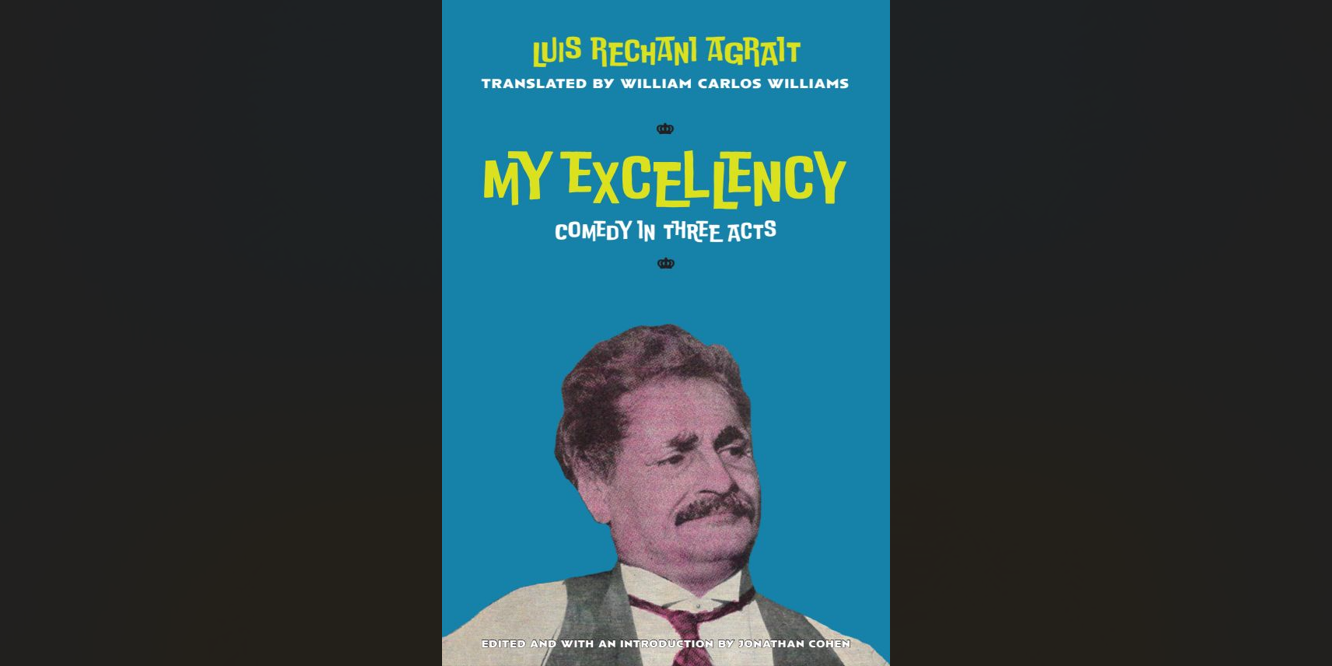
My Excellency: Comedy in Three Acts (Swan Isle Press, 2025) by Luis Rechani Agrait was translated into English by William Carlos Williams but not published in his lifetime. This first-ever edition of Williams’s translation was edited and has an introduction by Jonathan Cohen. It includes a foreword by Julio Marzán and an afterword by José Luis Ramos Escobar. It also includes the lecture Williams gave on poetry at the 1941 Inter-American Writers’ Conference of the University of Puerto Rico, where he met Rechani Agrait and received from him the published play as a gift.
William Carlos Williams’s English translation of the play, Mi Señoría, by Puerto Rican playwright Luis Rechani Agrait, reflects Williams’s connection to his Puerto Rican roots and deft skills as a translator. The play is a satirical critique of political corruption, featuring comical malapropisms and an idealistic but naive politician’s rise, highlighting themes of materialism and power, and showcasing Williams’s adept handling of language.
William Carlos Williams’s mother, Raquel Hélène Rose Hoheb Williams, was from Mayagüez, Puerto Rico. Williams was deeply engaged with translation and the unique cultural worlds wrought by migration. His rendering of My Excellency invites us to think about translation not simply as a linguistic act, but as an ethical and artistic one: What happens when a Puerto Rican political satire crosses languages, audiences, and power structures? What is gained, what is altered, and what remains unresolved? In this episode, Jeffrey Herlihy-Mera (UPR-M) and editor Jonathan Cohen discuss the historical context of the play, Williams’s role as translator, and the broader questions the work raises about voice, authority, and cultural mediation. By looking closely at My Excellency, we open a wider conversation about literature in translation and the complex relationships between language, migration, text, and translation.
This conversation forms part of the STEM to STEAM initiative, sponsored by the Teagle Foundation, which seeks to connect medicine, science, technology, and engineering with the interpretive and ethical sensibilities cultivated in the humanities. By foregrounding literature, poetry, history, philosophy, and the arts, the initiative reimagines how humanistic study can serve as a central component of technical and scientific education.
In this episode are:
-
-
-
- Jeffrey Herlihy-Mera, Professor of Humanities at the University of Puerto Rico-Mayagüez (UPR-M) and Director of the Instituto Nuevos Horizontes.
- Jonathan Cohen is an award-winning translator of Latin American poetry and scholar of inter-American literature. He is editor of Williams’s verse translations from Spanish, By Word of Mouth, and his translation of the Spanish Golden Age novella The Dog and the Fever.
-
-
Topics discussed and scholars mentioned:
-
-
-
- Emilia Quiñones Otal, Directora del Departamento de Humanidades, UPR-M
- Julio Marzán, The Spanish American Roots of William Carlos Williams.
- Marta Aponte Alsina
- “The Art and Science of Translation“
- Rebecca Ruth Gould and “co-translating”
- William Carlos Williams Society 2024 conference at the UPR-M
- Last Nights of Paris, Philippe Soupault
- “Translation will motivate English to do new things … to serve as an apprentice to a master writer.”—Jonathan Cohen
- “The Sugarcane Girl who was my mother”
- Walter Scott Peterson podcast, “[M]y ‘case’ to work up’: William Carlos Williams’s Paterson”
- “Williams struggled throughout his life, and the conflict produced great literature.”—Jonathan Cohen
- David Unger
-
-


—
My Excellency es un recordatorio de cómo los textos viajan y cómo se pueden transformar, siguiendo generando conversaciones décadas después. Entender como fue que se tradujo fue y también las dificultades que se pueden presentar con un trabajo así es algo sumamente interesante para mi. Ver como surge la traducción no es solo un dato curioso, se ve su relación grande con el pueblo de Puerto Rico y su traducción captura cierto humor, tropezas lingüísticas y critica la modernidad actual y se ve muy claramente la manera en el que todo esto marcó su vida con un punto de vista diferente de la cultura y como de variada es. Tocando tema como el hecho de tener autoridad de quien puede producir es algo que le puede abrir los ojos a muchas personas que les interese estar involucrado en la traducción de ciertos textos. Me impresionó el hecho de cómo puede cambiar algo cuando es traducido ya que no todo es lo mismo cuando cambias de frontera de lenguaje y algunas cosas se pierden en traducción. Por todo esto siento que este podcast es una manera de abrir los ojos y apreciar lo mucho trabajo que se pasa cuando alguien traduce un texto y que debemos de agradecerlos más ya que no es fácil en lo mínimo con todos los retos que se tienen que enfrentar.