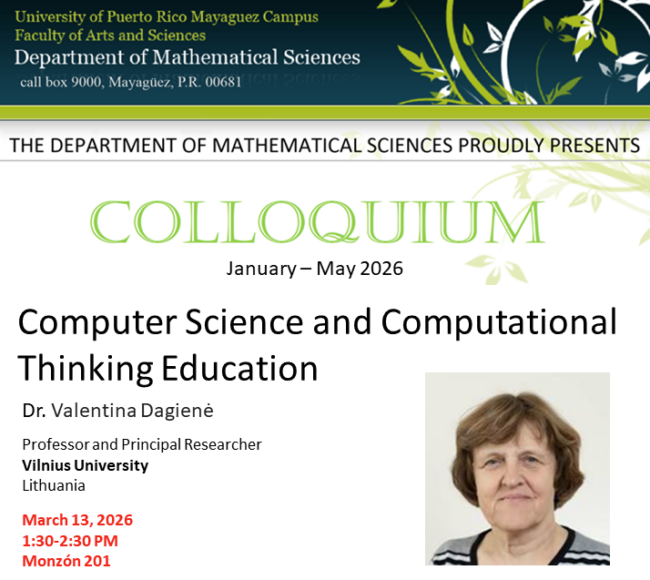
Computer Science and Computational Thinking Education

Abstract: Modem education requires our students to develop 21st-century problem-solving skills. This presentation offers an in-depth look at the integration of Computer Science and Computational Thinking at the primary and secondary education levels. Through a practical approach, we will discuss how gamification—highlighting the highly successful model of the Bebras Challenge—can motivate students and facilitate the…

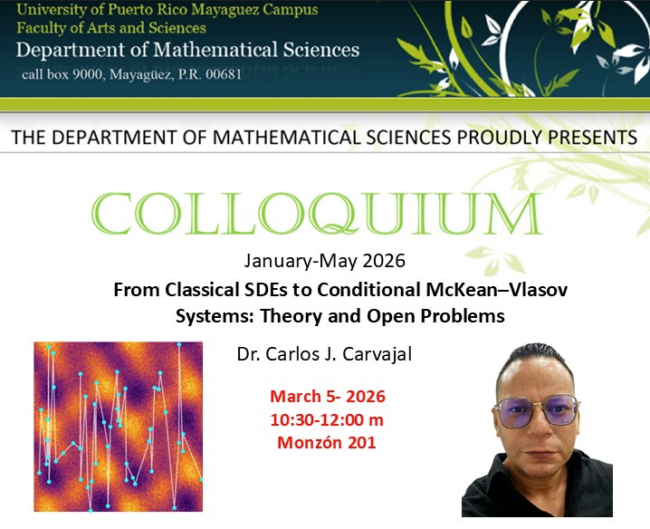
From Classical SDEs to Conditional McKean-Vlasov Systems: Theory and Open Problems

Abstract: This talk presents a structured overview of stochastic differential equations (SDEs), beginning with classical Itô diffusions and progressively incorporating jumps, regime switching, and interacting particle systems. We then introduce McKean—Vlasov equations, where the dynamics depend on the law of the solution itself, highlighting their nonlinear and mean-field nature. Particular emphasis is placed on conditional…

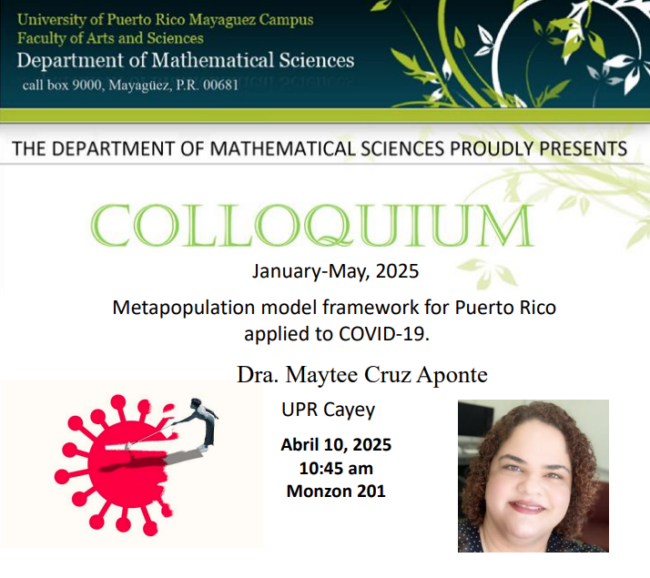
Metapopulation model framework for Puerto Rico applied to COVID-19.

Abstract: The COVID-19 pandemic has highlighted significant challenges for public health systems worldwide, demonstrating not only the lethality of infectious diseases but also the critical role of public behavior that influence case numbers and mortality rates, particularly in geographically isolated regions like Puerto Rico. This study presents a metapopulation model framework to analyze the transmission…

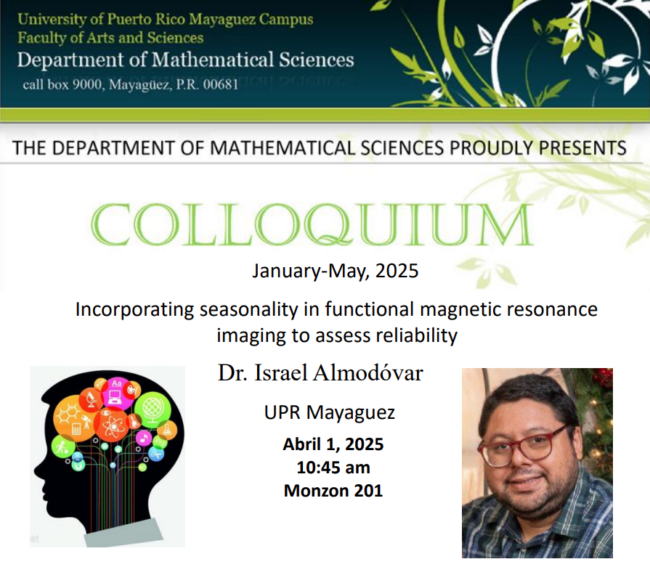
Incorporating seasonality in functional magnetic resonance imaging to assess reliability

Abstract: Functional magnetic resonance imaging (fMRI) is a noninvasive tool for studying regions related to some particular stimulus. To find these regions, the stimulus is typically applied in the form of event-related or block-design. Due to this, fMRI experiments have a natural seasonal pattern. In this work, we used different seasonal time series models in…

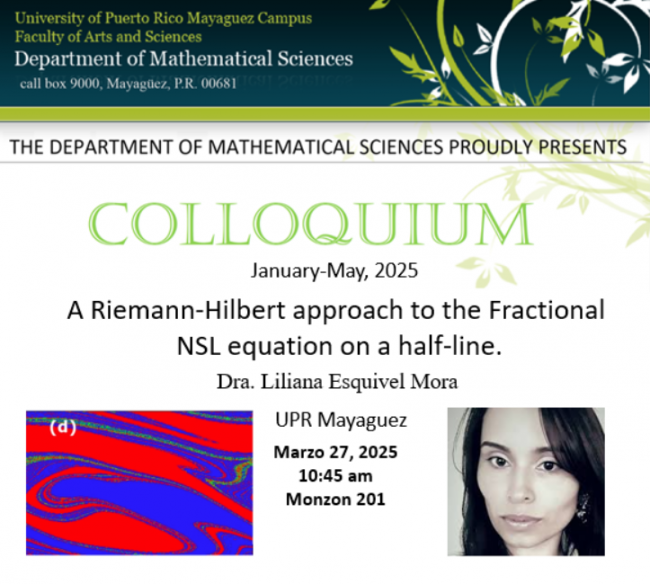
A Riemann-Hilbert approach to the Fractional NSL equation on a half-line.

Abstract: The fractional Schrodinger equation generalizes the standard Schrodinger equation by incorporating fractional derivatives, extending traditional quantum mechanics through fractional calculus. This approach provides a more flexible framework for modeling quantum systems with anomalous diffusion or complex geometries. Research in this field is dynamic, with ongoing exploration of both theoretical foundations and experimental implications, offering…

Dynamics of AMR beyond a single bacterial strain

Abstract: In this presentation, we explore the growing threat of antimicrobial resistance (AMR), a major global public health issue that complicates the elimination of harmful microorganisms in the host. Mathematical models have significantly contributed to the understanding of AMR dynamics and identifying strategies to combat bacterial infections, although they have primarily focused on single bacterial…